

“It’s not meant as just a pure collection of knowledge for knowledge sake. It’s meant to create conversation. It’s meant to engage with,” said Jennifer Bazar, curator at Lakeshore Grounds Interpretive Centre describing her work. Lakeshore Grounds Interpretive Centre was established in 2016 as part of a land agreement with the City of Toronto to serve the community.
The objective of the interpretive centre is to “research, preserve and share the natural and built histories” of lakeshore grounds. “Everything that we do is based on historical research on the grounds,” said Bazar. “Preservation is also a big piece of that.”
The interpretive centre educates the community through different exhibits and tours like park history tour, film history tour and tunnel tour. Their work primarily revolves around the themes of Indigenous heritage, mental health, education and environmental sustainability. “We call them our pillars because they were the foundational pieces on which we were established,” said Bazar.
Lakeshore grounds are located on traditional territory of the Ojibwe Anishinaabe. The lakeshore grounds now also have a park that habitats several hundred species of birds.
“Today it is this multi-habitat park that supports, you know, several hundred species of unique birds. It’s one of the top bird locations in the area. It’s got beavers, mink, coyotes, turtles,” said Bazar. “It’s a little paradise.”
Beyond natural habitat, the lakeshore grounds hold many other stories and resources. The architecture, film history and the psychiatric hospital history are other defining aspects of the lakeshore grounds.
“The walking tours are kind of the core of our programming,” said Bazar. The interpretive centre conducts different walking tours such as the tunnel tour, park history tour and film history tour.
The tunnel tour explores the history and stories of the Lakeshore Psychiatric Hospital. “It remains kind of our top programming piece because it was what was known even before we existed. It had a pre-life before the interpretive center,” said Bazar.

The psychiatric hospital opened and started receiving its first patients in 1890 and ran till 1979. During its tenure, the facility housed many people and each of them had their own story and perspective to the psychiatric hospital.
The facility was built and maintained by the patients and the staff collectively. The male patients were responsible for things like constructing and maintaining the facility along with farm work and the female patients were responsible for stuff like cleaning, laundry and kitchen.
“The labour is kind of the majority of your day. And because it’s originally framed as a part of your treatment and such a core element of your treatment, you’re not going to get paid for that. You’re also not going to get much of a choice in that work either,” remarked Bazar about the life of the patients.
Although the treatment was initially part of a treatment philosophy called “Moral Treatment”, these practices continued even after the institution moved away from the treatment philosophy. “It became just a part of what institutional life was like,” said Bazar.
One of the other contributions of moral treatment philosophy is the development of the facility itself on the lake shore. “They (institution) want them (patients) looking out over nature, not industry,” said Bazar.
“They (institution) spend the first two decades just planting trees and gardens and putting in walking paths.”
“The hospital always comes first for me,” said Bazar. “It is the lasting piece of both the patients and the staff. They are the ones who built and maintained those spaces. The lived in those spaces.”
“This is sort of the closest we can get to kind of their world, if you will. And so, when I see those buildings, it for me really resonates.”
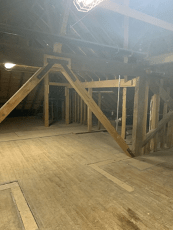
Bazar argued that one of the reasons the interpretive centre was founded was to engage with the topics and complexities of institutionalization.
“There were bad things, there were good things,” said Bazar, “It’s a tough topic to talk about. We can do that in a more respectful way by just trying to bring to life what happened here.”
The closing of the facility also left a negative mark in the history. With most of the patients being released without any support and all the staff laid off, the city saw a big spike in homelessness.
“We ended up with all sorts of struggles in terms of a housing crisis,” said Bazar. “Of course, there’s been other things that have added onto those crises in the interim, but it’s first wave.”
Lakeshore grounds have also been a popular filming location since last century. Film history tour explores that aspect of the grounds. The centre also hosts screenings of those films.
“We recognize the fact that different audiences are going to engage with different types of events. We know that not everyone’s going to come to all the same thing. So, we try to keep a variety of things going.”
Bazar argues that even though the tours and exhibits are a good resource for the community, they are a “snapshot way” of looking at things. “So, what we’ve been doing with our staff and our volunteers is that we’ve been working on creating a few web resources for lakeshoregrounds.ca.”
“I think digital options are really big for museums, historical societies, researchers and all that kind of thing right now,” said Bazar. “This is the way they expand.”
Bazar believes that the interpretive centre is at the beginning of the process a lot of time. “We are constantly learning. There’s always something, but it’s actually very exciting,” said Bazar. “It’s like every week I learned something new about the grounds here.”

 Hansil Mehta